What to do if the Wi-Fi item in Windows 11 Settings has disappeared

This time, we will introduce what to do if the "Wi-Fi" item in "Settings" in Windows 11 disappears.

This issue seems to occur particularly frequently immediately after installing updates via Windows Update or in environments where a major Windows 11 update has been applied.

Settings - Network and Internet
Settings – Network and Internet
table of contents

Reasons why the Wi-Fi item in Settings disappears and how to fix it

Cause

The reason why the "Wi-Fi" item does not appear in "Settings" is

  • The Wi-Fi network adapter is disabled
  • The Wi-Fi network driver is not installed
  • The Wi-Fi network adapter itself is broken.
  • Bluetooth Wireless LAN Cordless handsetIf you are using this, there may be a problem with the Bluetooth driver or something similar.

One of the following is possible.

In the above case, "Wi-Fi" will not work and you will not be able to connect to the Internet via "Wi-Fi (wireless)."

Task tray (notification area)The "Wi-Fi" icon will also change to a globe icon.

task tray
task tray

Even if you click this icon to open "Quick Settings," "Wi-Fi" will not be displayed.

Quick setting
Quick setting

approach

1. If the Wi-Fi network driver is not installed

If there is no Wi-Fi option in "Advanced Network Settings," it is possible that the Wi-Fi network driver is not installed. Using another PC or smartphone, download the "Wireless LAN driver (Wi-Fi driver)" for your model from the manufacturer's official website and install it via USB memory or other device. *If the device came with a driver CD when you purchased it, you can also install it from that.

If you still can't find the driver:

Comments orContactIf you contact us with the following information, we will check the driver distribution page.

  • PC manufacturer and model number(Example: NEC LAVIE N15xx/xx)
  • OS version(Windows 10 or Windows 11)
  • current situation(Device managerThere is an exclamation mark in

4 ways to check the specs (performance, specifications) of your Windows 10/Win11 PC

*Please note that for older PCs, the manufacturer may no longer provide drivers.

If this problem occurs immediately after applying a major Windows 11 update or the latest update, it's possible that older drivers are being blocked due to enhanced OS security (vulnerability countermeasures). In most cases, this can be resolved by obtaining and updating to the latest drivers from the manufacturer's website.

2. If the Wi-Fi network adapter itself is disabled

1. Press Windows Key + R to open Run, type one of the following commands and press Enter:

ncpa.cpl

or sending us a message on

explorer ::{7007ACC7-3202-11D1-AAD2-00805FC1270E}

2. "Network Connections" will be displayed, so check the "Wi-Fi" icon.

Network connection
Network connection

If the "Wi-Fi" icon is grayed out (displays "Disabled"), the "Wi-Fi" item will no longer appear in "Advanced Network Settings."

In this case, double-click the "Wi-Fi" icon or right-click and click "Enable" to enable it.

If the "Wi-Fi" icon does not exist here, the Wi-Fi adapter (receiver) is not recognized. The following may be the cause.

3. Check the BIOS settings or check for hardware (adapter) failure.

In rare cases, the Wi-Fi function itself may be disabled in the settings of the PC's underlying system (BIOS/UEFI).

approach: When starting up the PCManufacturer-specified keys (such as F2 or Delete)Press to enter the BIOS screen and check that items such as "Wireless LAN" or "WLAN" are not set to "Disabled." If you cannot find the item or are unsure about it, you may be able to resolve the issue by performing "Initialize Settings (Load Default Settings, etc.)" in the BIOS menu.

[If it still doesn't work] If you have tried all of the above and the Wi-Fi icon still does not appear or the driver does not install, there is a high possibility that the Wi-Fi components inside your PC are physically broken.

  • repair: Contact the manufacturer or a repair shop (this may be expensive).
  • Alternative: Purchase and install a "USB wireless LAN adapter (Wi-Fi adapter)" available at electronics retailers.
    • *It can be purchased for a few thousand yen and allows you to use Wi-Fi simply by inserting it into a USB port, so it is recommended as a simple solution.

4.Bluetooth wireless LAN Cordless handsetIf you are using

If you are using a USB wireless LAN adapter that combines Wi-Fi and Bluetooth functionality, driver conflicts or Bluetooth issues can sometimes cause the Wi-Fi option to disappear as well. First, try unplugging the adapter from the USB port and plugging it into a different port (preferably one on the back of your PC) to see if it is recognized correctly.

*Recently, after applying Windows Update on Windows 11, a problem has been reported where "Bluetooth suddenly stops working" or "the Bluetooth option disappears from the settings screen." If both the Wi-Fi and Bluetooth options have disappeared, please also try the troubleshooting steps in the following article.

If the "Wi-Fi" item is displayed but you cannot connect to the Internet

1. "Advanced Network Settings"

1. Right-click on the "Wi-Fi" icon in the task tray (it may look like a globe) and click "Network and Internet Settings."

Right-click on the globe icon in the task tray

2. Open "Settings" > "Network & Internet" and click "Advanced network settings" at the bottom.

Settings - Network and Internet
Settings – Network and Internet

3. The "Advanced Network Settings" window will open. Check the right side of the "Wi-Fi" item under "Network adapters." Does it say "Enable"?

Settings - Network and Internet - Advanced Network Settings
Settings – Network and Internet – Advanced Network Settings

If it says "Enable," try clicking it.

Once it changes to "Disabled," the "Wi-Fi" network adapter will be enabled and you will be able to connect to the Internet.

2. If the SSID is not displayed

If the "Wi-Fi" network adapter is enabled but the SSID is not displayed, please check the following:

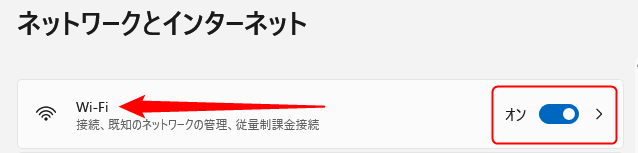
1. Is "Wi-Fi" turned on in "Settings" > "Network & Internet"?

2. If it is set to "On," click on the word "Wi-Fi."

"Settings" > "Network and Internet" – Wi-Fi

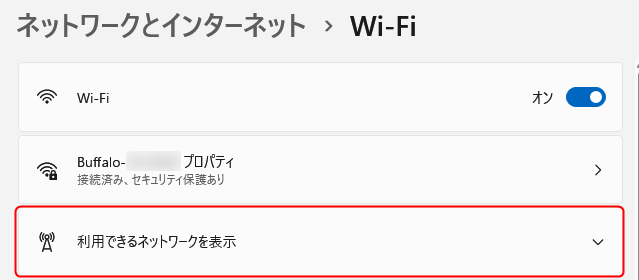
3. Click "Available Networks"

"Settings" > "Network & Internet" > "Wi-Fi"

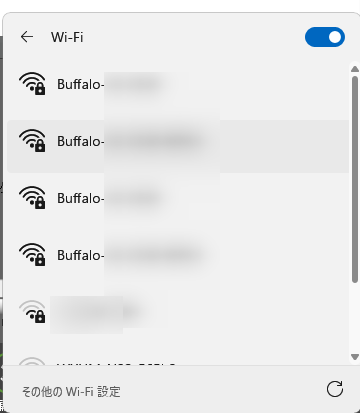
Normally, multiple SSIDs (such as your Wi-Fi) will be displayed. (We will proceed assuming that nothing is displayed here.)

"Settings" > "Network & Internet" > "Wi-Fi" - Available networks
"Settings" > "Network & Internet" > "Wi-Fi" – Available networks

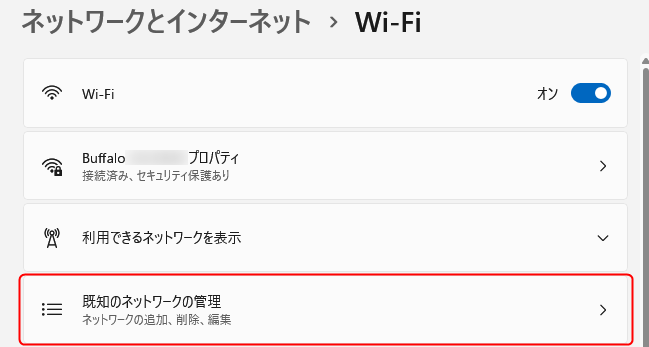
4. If nothing is displayed under "Available Networks," try clicking "Manage Known Networks" below it.

"Settings" > "Network & Internet" > "Wi-Fi"

5. SSIDs you have previously connected to are displayed here. If an SSID is displayed, click the name of the SSID you want to connect to.

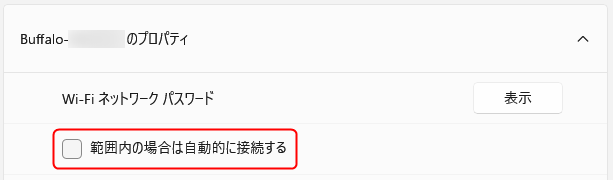
6.There is a checkbox here that says "Connect automatically if within range", so please check it.

SSID Properties
SSID Properties

If there are no other problems, you should be able to connect to the network automatically.

3. If you can't connect

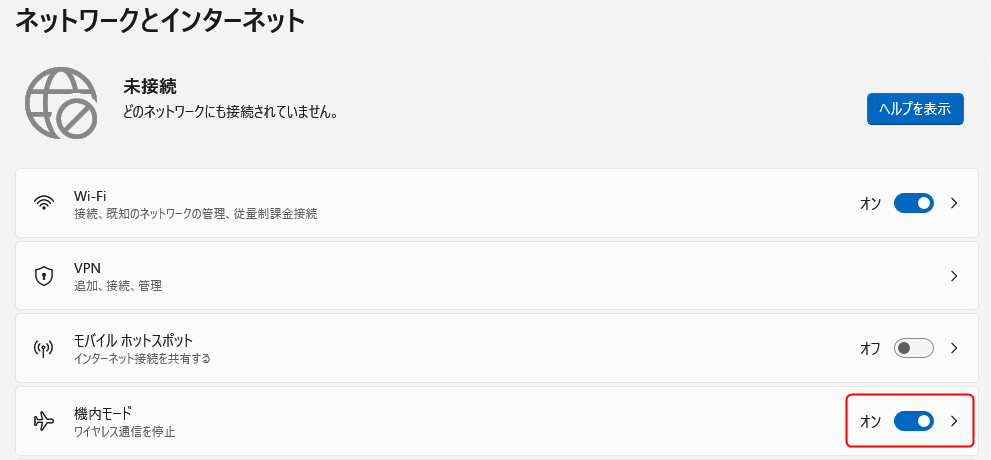
If you are unable to connect using the above two methods, go back to "Settings" > "Network & Internet" and check if "Airplane mode" is "On."

"Settings" > "Network and Internet"

Especially if you are using a laptop, having airplane mode "on" can cut off all networks.

4. Reset your network

If you are unable to connect even after turning Airplane Mode off, try performing a network reset and then restarting your PC.

*Please do not shut down and then start up.Start buttonRight-click > Shut down or sign out > Restart to restart the computer.

How to reset your network in Windows 10/11

5. Restart your router

If you still can't connect after resetting your network, try restarting your Wi-Fi router.

procedure:

  1. Turn off your Wi-Fi router
  2. Turn off the modem (ONU)
  3. Leave it for 5 to 10 minutes
  4. Turn on the modem (ONU)
  5. Power on your Wi-Fi router

If you are unable to connect, try restarting your PC.

6. Uninstall updates

If you experience network problems after updating with Windows Update, you may be able to connect by uninstalling the update.

[Solved] Can't uninstall Windows updates? A detailed explanation of the causes and solutions

The update uninstall screen will display the installation date, so try uninstalling the update that was installed when the problem occurred.

更新プログラムをアンインストールする

How to Pause Windows Update on Win10/Win11

7. System Restore

If all of the above doesn't work, try doing a system restore to a date when the problem was not there.

What you think is caused by installing an update might actually be a different problem, such as user error or third-party software that has made changes to your system. In these cases, System Restore can be very helpful.

How to create, restore, and delete system restore points

2025/10/08 Update: BIOS issues can sometimes cause Wi-Fi to become unusable.

BIOS is the underlying program that manages all of your PC's hardware.

When Windows makes changes to the core parts of the OS in a major update, older BIOS may not be able to keep up with the changes, which can cause problems with communication with hardware (keyboards, Wi-Fi/Bluetooth chips, etc.).

*To "cause discrepancy" means that a discrepancy arises and things do not go smoothly.

There have been cases where updating the BIOS to the latest version improves compatibility with the OS and resolves previously unsolvable issues.

This is because PC manufacturers include fixes in BIOS updates to accommodate OS changes.

[Important] Things you must check before updating your BIOS

BIOS updates are a very powerful solution, but if you perform them incorrectly, there is a risk that your PC will no longer boot (become bricked). Please proceed with caution and at your own risk.

Preparations and confirmation itemsDescription
Data backupTo be on the safe side, be sure to back up any important data to an external hard drive or the cloud.
Check the motherboard model numberUsing the wrong BIOS file will damage your PC. Be sure to enter the wrong model number. Press Windows key + R to open "Run", type "msinfo32", and press Enter. You can check the "Baseboard Manufacturer" and "Baseboard Product" in "System Information".
Ensuring stable power supplyA power outage during the update process can be fatal. If you are using a laptop, connect both the AC adapter and the battery, and if you are using a desktop PC, perform the update on a day with stable weather, etc., to ensure that the power will not go out.
Use of the manufacturer's official websiteAlways download the BIOS file from the official website of your PC or motherboard manufacturer.Files downloaded from unofficial sites may contain viruses, spyware, or other malicious programs, or may be outdated, corrupted, or even a slightly different version than your PC model.

Updating the BIOS to the latest version can sometimes cause drivers such as Wi-Fi to become unusable (blocked).

The Secure Boot certificates (2011 version) currently used on many PCs will begin to expire one after another starting in 2026. As a result, BIOS currently released by manufacturers may already contain the new Secure Boot certificates (2023 version).

[Warning] BIOS manipulation can make your PC unbootable? Three measures to prepare for Secure Boot updates

General BIOS Update Procedure

The procedure varies depending on the make and model, but the general steps are as follows:

  1. Download the BIOS file:
    • Go to the support page of your motherboard manufacturer (ASUS, GIGABYTE, MSI, ASRock, etc.).
    • Search for your exact model number and download the latest BIOS file.
    • The downloaded file is in ZIP format (extension Since there are many ".zip" files,UnzipI will do it.
  2. Preparing the USB flash drive:
    • Prepare a USB memory stick formatted in FAT32 format.
    • Copy the extracted BIOS file (with extension such as ".CAP" or ".ROM") to the root directory of the USB memory (the directory directly below it, not in a folder).
  3. Booting to BIOS screen (UEFI):
    • Restart your PC and while the manufacturer's logo is displayed immediately after startup, press the "Delete" or "F2" key (see below) repeatedly to enter the BIOS screen.
  4. Run the update tool:
    • On the BIOS screen, find an update tool called "EZ Flash," "Q-Flash," or "M-Flash" and launch it.
    • Once the tool recognizes the USB stick, select the BIOS file you copied.
  5. Run and wait for the update:
    • A final confirmation message will appear to confirm whether the file is correct, so confirm and run it.
    • Do not turn off the PC or remove the USB memory during the update.
    • Once complete, your PC will automatically restart. It may restart multiple times, but this is normal.

Generally, after updating the BIOS, you will need to reset the settings (this may happen automatically). (This is explained on the manufacturer's website.)

For example, in my environment, after updating the BIOS, follow the steps below.

  1. Open the BIOS screen and note down the settings such as Secure Boot and CSM.
    • In my environment, "Secure Boot" must be enabled and "CSM" must be disabled in order to start Windows 11.
  2. On the following screen, click "Restore UEFI BIOS defaults"
  3. Save settings and reboot
  4. Open the BIOS screen again and check the Secure Boot and CSM settings.
  5. If the settings are different from those you noted down, return them to their original settings.
  6. Save the settings and restart
  7. Start Windows 11
Motherboard model: B550M-P4 – BIOS screen

ASRock B550M Pro4 Motherboard BIOS Update Method and Notes

Major motherboard manufacturer support pages:

Common manufacturer shortcut keys use one of the following keys:

  • Delete, ESC, F1, F2, F8, F9, F10, F12

After turning on your computer, immediately press the keyboard shortcut key several times.

We will introduce shortcut keys for some manufacturers, so please use them as a reference.

Shortcut keyMake
F2Sony, Dell, Acer, FUJITSU, Samsung, ASUS
F2 or F10HP
F1ThinkPad
Press ESC and then F1, or F2TOSHIBA
F2 or Fn + F2Lenovo
If you found this article helpful, please share it on social media.

Person who wrote this article

Driven by questions arising from my daily PC use and the desire to "do more," I have been pursuing self-study in Windows since around 2008. I am sharing the "aha!" techniques and solutions I discovered through trial and error with the sole purpose of helping you in your PC life.

View profile

Comment:

To comment

[About submissions]
We welcome any questions or information regarding the content of the article.
However, please note that content unrelated to the purpose of the article, criticism of specific individuals or organizations, offensive language,Inappropriate wordsComments containing the above may be deleted or made private without notice at the discretion of the administrator.
Please note that spam may be automatically deleted by anti-spam measures.

CAPTCHA


table of contents