Use the Win10/Win11 System Diagnostic Tool to find the cause of your problems!

This time, we will show you how to diagnose your Windows 10 and Windows 11 systems without using third-party software.

Have you ever had trouble with a malfunction while using your PC?

Windows has a default system diagnostic feature, so if you have a problem with your PC, try diagnosing it.

table of contents

How to run system diagnostic tools

1. Press Windows key + R to open Run.

2. Type "control" and press Enter.

3. Switch the view to "Large Icons" for all Control Panel items.

4. Double-click "Windows Tools" to open it.

Control Panel > All Control Panel Items

5. Double-click “Performance Monitor” to open it.

Control Panel > All Control Panel Items > Windows Tools

6. Double-click "Data Collector Sets" on the left side of "Performance Monitor" > double-click "System".

7. "System Diagnostics" will be displayed, so right-click on "System Diagnostics" and click "Start".

パフォーマンスモニター
パフォーマンスモニター

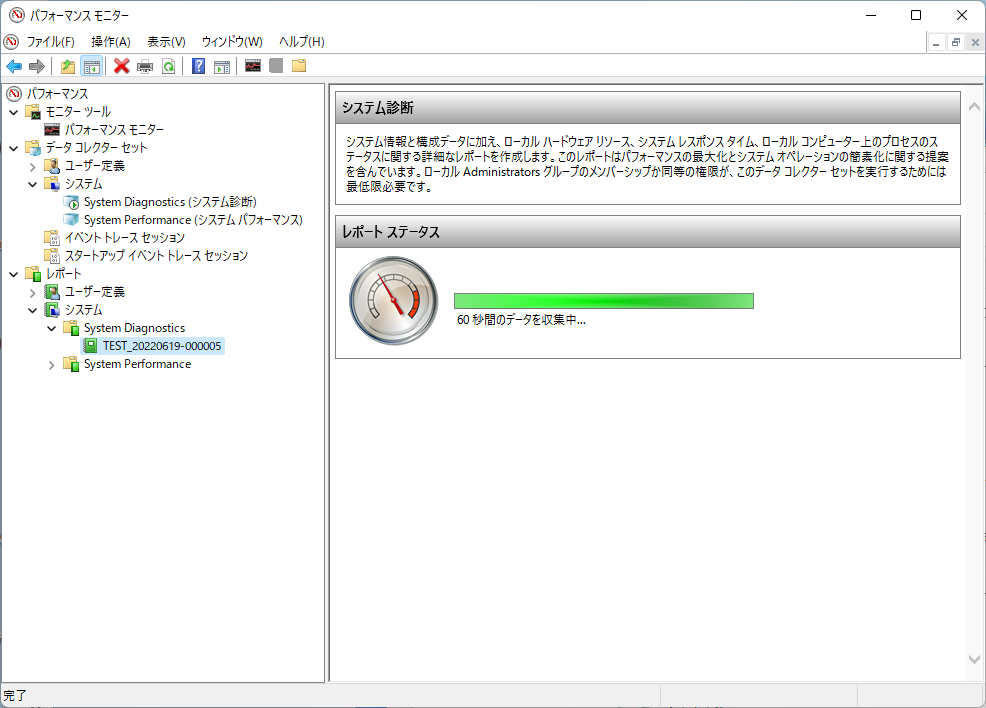
8. The system will begin to diagnose, so please wait for one minute.

*You can also create a report using the command "perfmon /report," but sometimes data collection may not finish even after 60 seconds. The method described in this article will allow you to do so without any problems.

On the left menu, click Reports > System > System Diagnostics > "User name_date-sequential number” (the one with the most recent date and the largest sequential number) is the report you are currently creating, so clicking on it will take you to the next screen.

There may be multiple report files, for example, if you have created reports before.

Performance Monitor - Report Status
Performance Monitor – Report Status

9. After one minute, the report will start to be created automatically, so please wait a while.

Performance Monitor - Reporting
Performance Monitor – Reporting

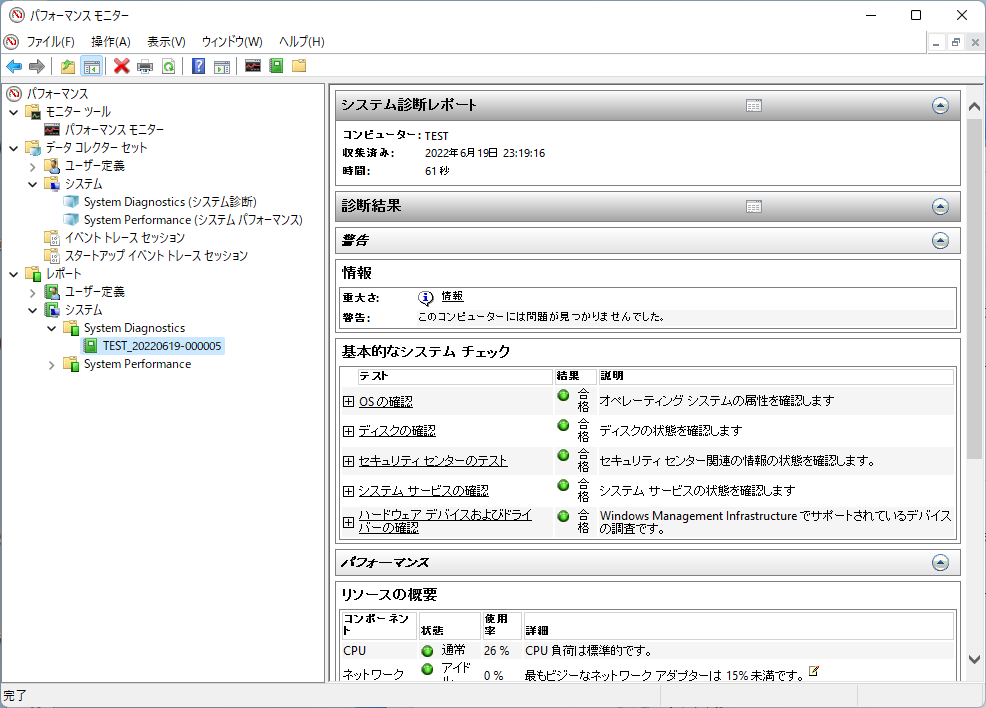
10. Once the report is created, the System Diagnostic Report will be displayed on the right.

Performance Monitor - System Diagnostic Report
Performance Monitor – System Diagnostic Report

If there is a problem, a warning will be displayed as follows:

A warning is displayed in the system diagnostic report

Please check the symptoms, causes, details, and solutions that are displayed.

*In the image above, you can see that there is a problem with the driver.

Please read the system diagnostic report carefully to find the cause of the problem.

If you found this article helpful, please share it on social media.

Person who wrote this article

Driven by questions arising from my daily PC use and the desire to "do more," I have been pursuing self-study in Windows since around 2008. I am sharing the "aha!" techniques and solutions I discovered through trial and error with the sole purpose of helping you in your PC life.

View profile

Comment:

Comment list (2)

  • I upgraded from Windows 10 to 11. After the installation was completed successfully and I restarted the computer,
    The message "Warning: Unable to boot from the selected device. {Continue}" appears on the PC screen, and when you try to continue,
    , launch menu, application menu
    1.Windows BOOT Manager 2.Dr ive0:Hdd:WDC WD3200LPUX-16UOTTO 3.→NETWORK:
    No matter what I try, the PC screen returns to the warning screen.
    When I checked with the FMV diagnostic tool, the hard disk check items could not be cleared.
    I am back to the warning screen. Is there anything I can do in this situation?

    • Thank you for your comment, Katsuhiko Takahashi.

      I can't say for sure because I don't know the model number of your PC, but is your PC compatible with Windows 11?
      If it does, it may not be booting due to a BIOS setting.

      For example, in Windows 11

      • "Secure Boot" must be enabled.
      • CSM must be disabled.

      First, check the above two points, select "1. Windows BOOT Manager" as the boot order, save the settings, and then try booting.
      *If you upgraded using a USB memory stick, and the installation of Windows 11 is complete, remove the USB memory stick before starting up.

      If you are unable to boot, it is possible that your BIOS version is outdated, so please contact the manufacturer's website.

To comment

[About submissions]
We welcome any questions or information regarding the content of the article.
However, please note that content unrelated to the purpose of the article, criticism of specific individuals or organizations, offensive language,Inappropriate wordsComments containing the above may be deleted or made private without notice at the discretion of the administrator.
Please note that spam may be automatically deleted by anti-spam measures.

CAPTCHA


table of contents